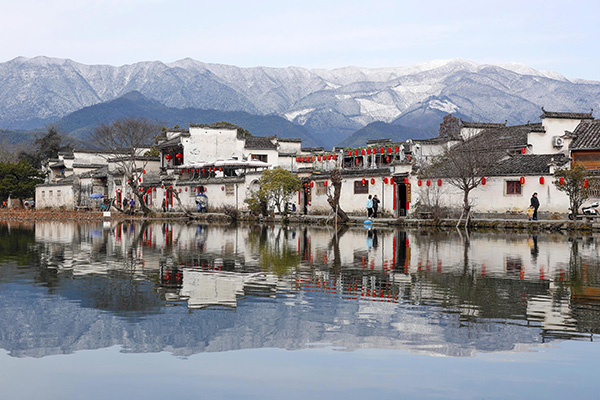
Hongcun Village
Overview of Hongcun Village
Hongcun Village, located in Yixian county of Huangshan city, in southern Anhui province, China, is renowned for its well-preserved vernacular architecture and layout that reflects the characteristics of Anhui villages from the 14th to 20th centuries. It boasts a unique design that resembles the shape of an ox when viewed from a distance. This traditional village is a depiction of the harmonious coexistence between human habitation and nature, featuring intricate waterways, picturesque landscapes, and centuries-old buildings. As a part of the World Cultural Heritage List since 2000, Hongcun, along with the nearby Xidi Village, is a vital cultural site that attracts visitors from around the globe.
Historical and Cultural Significance
Hongcun Village has undergone over 1,000 years of continuous transformation and development, yet it has preserved its essence as a traditional Chinese village with a commercial economy and clan-based social structure. The village maintains key features typical of pre-modern settlements, such as its surrounding environment, man-made waterways, village layout, architectural style, decorative arts, construction methods and materials, as well as traditional technologies and the overall village appearance. Additionally, the site preserves regional arts, customs, cuisine, and other aspects of cultural and traditional life. Hongcun Village is an ideal location for contemporary society to explore its history and study traditional village culture.
Architectural Highlights
A typical traditional residence in Southern Anhui is divided into three sections, with an ingenious layout that creates a harmonious balance between unity, order, flexibility, and liveliness. The rooms are usually arranged symmetrically, with the main hall in the center, flanked by side halls. Stairs are often positioned in the main hall, and an indoor skylight near the entrance provides both lighting and ventilation.
The roofs of rural buildings are generally designed like upturned, half-opened books, with raised beams or gable roofs. The exterior walls are covered with black tiles in rippling or curling patterns, featuring small but intricately decorated windows. The main gate, framed with local stone blocks, often includes a beautifully adorned door casing made from stones or bricks. Family gardens are typically located in the front of the courtyard, though some are found beside or behind the building. Despite their modest size, these gardens are designed with great creativity, reflecting a deep poetic charm. The space is often divided and redefined by hollowed windows, doors, screens, and the strategic placement of flowers and plants, creating a refreshing and intricate atmosphere.
Main Attractions
Nanhu Scenic Spot
Nanhu Scenic Spot is one of the most famous landmarks in the Hongcun Village. The lake features a wide expanse of water, surrounded by willows on three sides and village cottages on the other. Viewed from outside the village, the scene is enchanting: ancient, verdant willows frame the sparkling green waters, where a classic stone arch bridge connects two long dikes that cut diagonally across the lake. In the soft glow of early autumn mornings, the ancient Hui-style residences of Nanhu Scenic Spot are reflected on the tranquil lake, creating a scene that leaves visitors in awe.
Hui-style Buildings
After the rain has passed, the village takes on a serene, almost ethereal quality. The dense cluster of traditional Hui-style buildings, surrounded by mist, resembles a Chinese ink painting. Strolling through this peaceful setting, visitors feel relaxed and immersed in the village's tranquil atmosphere.
Chengzhi Hall
Built in 1855 during the Xianfeng reign (1850–61), Chengzhi Hall was the residence of prominent salt merchant Wang Dinggui. The wooden building is adorned with elaborate bricks, stones, and wood carvings. Covering 2,100 square meters with a construction area of over 3,000 square meters, it remains a well-preserved example of traditional residential architecture.
Moon Pond
Moon Pond is located in the center of the village. Built during the Yongle period of the Ming Dynasty (1368-1644), it has a crescent shape symbolizing the idea that "flowers bloom and fall, the moon waxes and wanes." The water is green year-round, with a calm surface reflecting the sky, surrounded by stone paths, white walls, and blue tiles.
Lu Village
Located about 1 km north of Hongcun, Lu Village is part of Hongcun township in Yixian county, Anhui. Its ancient residences, built during the Qing Dynasty (1644-1911), were constructed by Lu Bangxie, a fourth-rank official. The village still preserves traditional buildings, including Zhicheng Hall, Siqi Hall, and Sicheng Hall.
Visitor Experiences
Hongcun Village offers a unique cultural experience for visitors through engaging workshops and local craft demonstrations. Visitors can explore the art of traditional Huizhou architecture, learn about local woodworking and wood carving techniques, and even try their hand at making Hui-style calligraphy or ink paintings. The village is also a gateway to nearby hiking trails, where nature enthusiasts can enjoy scenic walks through lush landscapes and tranquil surroundings, further immersing themselves in the beauty of Anhui's rural heritage.
Preservation and Sustainability
Hongcun Village is committed to preserving its rich cultural heritage while fostering sustainable tourism practices. The village's efforts to balance tourism with heritage protection include maintaining its centuries-old architecture and ensuring that new development aligns with traditional Huizhou aesthetics. Local authorities work closely with conservationists to safeguard the village's iconic wooden structures and picturesque landscapes. Moreover, sustainable tourism initiatives focus on minimizing environmental impact, encouraging responsible travel, and supporting local artisans.
Article reference1. Huizhou heritage comes to life. chinadaily.com.cn. 20222. Ancient Villages in southern Anhui - Xidi and Hongcun. chinadaily.com.cn. 2018Photo Gallery(14 pictures)CategoriesCultural HeritageTagHistorical and Cultural Town and VillageWorld Heritage in ChinaRural TourismRelatedArchitectural Craftsmanship for Timber-Framed StructuresChinese Traditional Architectural Craftsmanship for Timber-framed StructuresXidi VillageCatalogue1. Overview of Hongcun Village2. Historical and Cultural Significance3. Architectural Highlights4. Main Attractions5. Visitor Experiences6. Preservation and Sustainability-
- []








